
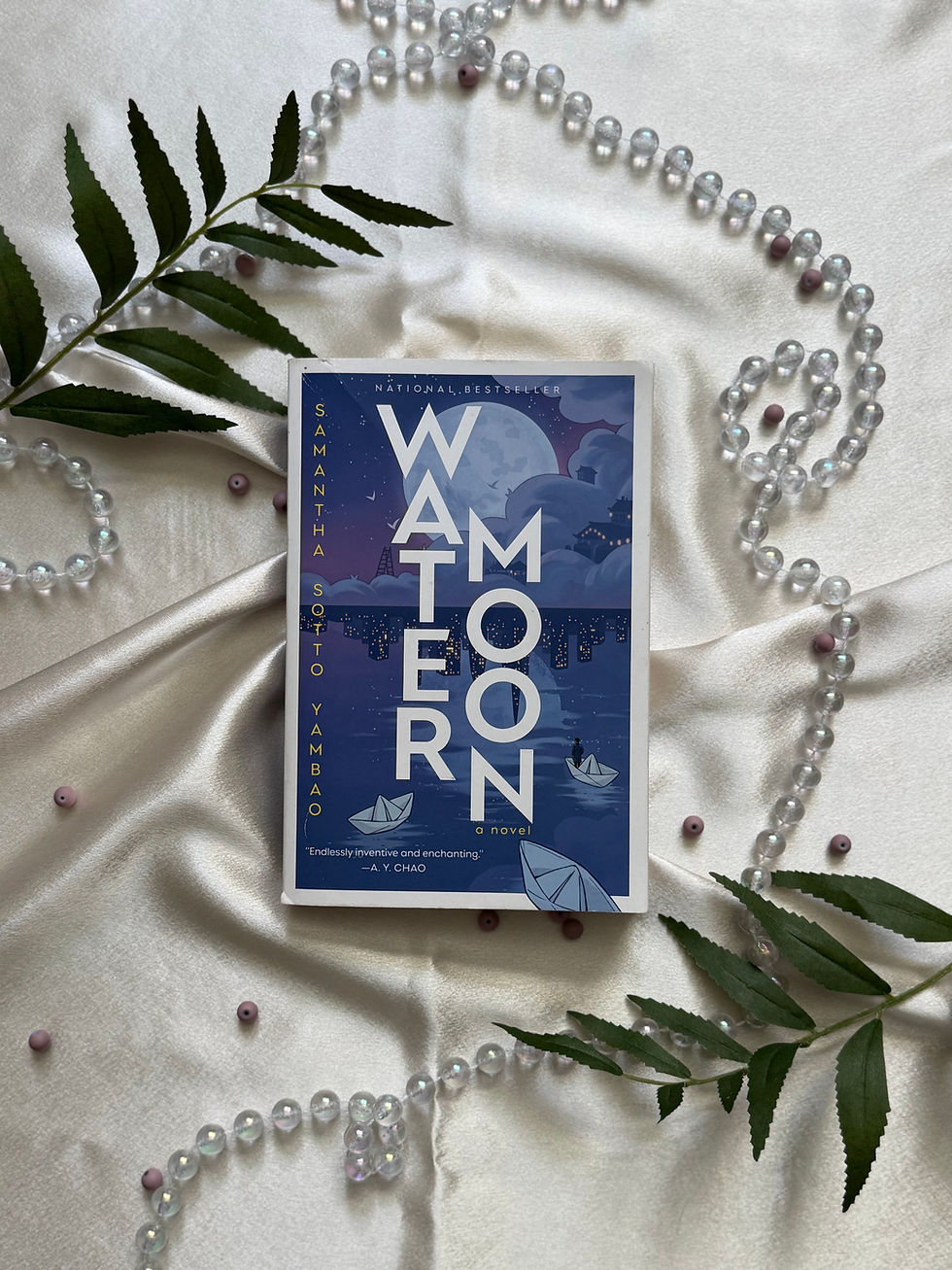
Water Moon by Samantha Sotto Yambao (2025)
Updated: Sep 27
Rating: ⭐⭐⭐ I wanted to love a lot of things about Water Moon. The concept was compelling and the world was wholly unique: origami birds made from mistakes, puddles as transportation portals, riding trains of thought, a market in the clouds, a town that makes the stars, and fate-tattoos only visible in the rain. All were beautiful, clever, and completely original ideas that I fell in love with. I give great credit to the author for her remarkable vision and applaud Water Moon for all it is.
Unfortunately, the execution of these wonders wasn't always there for me and I was left believing it could have been so much more than it was. I'm truly glad I read it, and it is worth your time for its pure originality, but I was consistently dogged by an unwelcome feeling of subtle disappointment. If you plan to read this book, enjoy it for what it is: a truly original book with a few flaws that hold it back. Join me on my train of thought as I dive deeper in the full review.
Overview:
Hana and her father live in another world and run a pawn shop for regrets. She wakes on the morning she's due to take over her father's work to find the shop ransacked, her father missing, and the most valuable item stolen. At the same time, a young man stumbles into the pawn shop and upon seeing Hana's distress, resolves to help her find her father and return the missing item. Together, they journey to strange and wonderful places within her world and try to set things right.
[SPOILERS BELOW THE PHOTO]
[SPOILERS BELOW]
General Impressions:
Water Moon was a beautiful novel. Truly. But it was also an unfortunate example of a great idea with average execution.
It felt like the author had so many wonderful ideas...but she didn't give them enough space to breathe. We didn't fully explore so many remarkable places and rushed from one place to another, puddle hopping (literally) with disjointed time cuts to move the plot along. I think this disappointed many readers; the world she created deserved much more attention and I got the impression she built the plot around it.
There are some great philosophical and speculative sparks throughout the novel, but they ultimately fade to nothing concrete. To make matters worse, they are often presented in clunky conversations that do everything to detract from the profound ideas. Maybe that was the point actually—that even the most impactful ideas are still so fleeting. Who can say for sure? But I for one wanted to dive deeper. Here's one I'd like to take a moment to highlight though:
"Happiness does not exist in a place. It lives in every breath we take. You need to choose to take it in, over and over again." (288)
Themes:
Let's begin with the concept of a Water Moon. The title is a translation of a Japanese idiom that refers to something that will forever be out of reach. In this case, the reflection of the moon in a pool of water— you can see it in perfect detail, but trying to touch it will cause the moon to disappear. There's another example used with a painting depicting a reflected scene in the curve of a wine glass: things that are real, but not. There, but always out of reach.
This theme runs throughout the book demonstrating the ephemeral nature of life itself: the time we have, the love we seek, even our very moment in existence is there and gone in the blink of an eye. Sotto Yambao explores this continually with her ever-shifting, dreamlike world.
Regret is another theme we see played out with the concept of the pawn shop, Kei's mother, and Hana's mother as well. Both women make an incredibly hard choice: one gives up her chance to become a mother. Another sacrifices everything to have a chance to be a mother. Both choices have dire consequences and the author seems to be asking whether our regrets break us or define us. And is there value in regret either way?
Fate and Free Will are continually brought up through Kei and Hana's relationship. Kei, being from our world, is free to choose his life's direction while conversely, Hana's life has been tattooed on her skin since infancy. Sotto Yambao shows us the duality of choice through their characters and their convictions throughout their journey.
Sacrifice is also scattered throughout the novel: the workers who make the stars, Haruto's hands, Hana's parents, Hana and Kei all make various sacrifices. Most of her world is built upon it and even borrowed souls of everyone in her world are, in a way, an unwitting sacrifice. It seems to suggest the value created from something given up.
Fatal Flaws:
Let's talk about the biggest drawback: the relationship between Kei and Hana. The insta-love made me shake my head in disappointment. You're telling me this man stumbles into a pawnshop, sees a girl with a small cut on her foot, and decides to immediately drop everything in his life to follow her on some absurd-sounding journey through a puddle? If someone I met did this after knowing me for 0.2 seconds, I'd question their sanity. There was no reason for his immediate devotion to her and for me, and when Hana questions it herself, his answers were unconvincing. To me, that's a big red flag for character development.
Then we go into their dialogue. Hana being mildly fascinated with her rain-visible fate-tattoos her whole life and then suddenly exclaiming, "Don't look at me, I'm hideous!" the moment Kei sees them was overdramatic and completely removed me from the story. The dialogue was YA at best, required an additional editing pass at worst.
The most upsetting thing about the dialogue was that it held the rest of the book back significantly. This story could have been considerably elevated; it could have been philosophical, outstanding, and deeply thought-provoking with a dream-like storytelling that had the potential to approach the level of The Alchemist. But when you place that delicate bird of potential next to the drooling ogre of their dialogue, that potential does not take flight.
The Ending:
The final few chapters of the book felt rushed if I'm being honest. It all felt like we had a lot of threads to wrap up and as the reader, you're suddenly running into several different conclusions, wondering if each is the last only to find another. The last lines of the book resolve the tension on whether or not Hana and Kei can be together, but I think that space would have been better spent on the philosophical throughlines the author popped in there but rarely developed. We get a happy ending, but it's ultimately unfulfilling.
Conclusion:
I think the hype the book originally got actually did it a disservice and it set a lot of readers up for disappointment. With more careful development around the dialogue and character relations, this book would have made a greater impact. I think that's a true missed opportunity.
So, would I recommend this book? Yes... as long as you are aware that it may not be everything it claims to be and should be read with an appreciation for what it does well.

Comments