
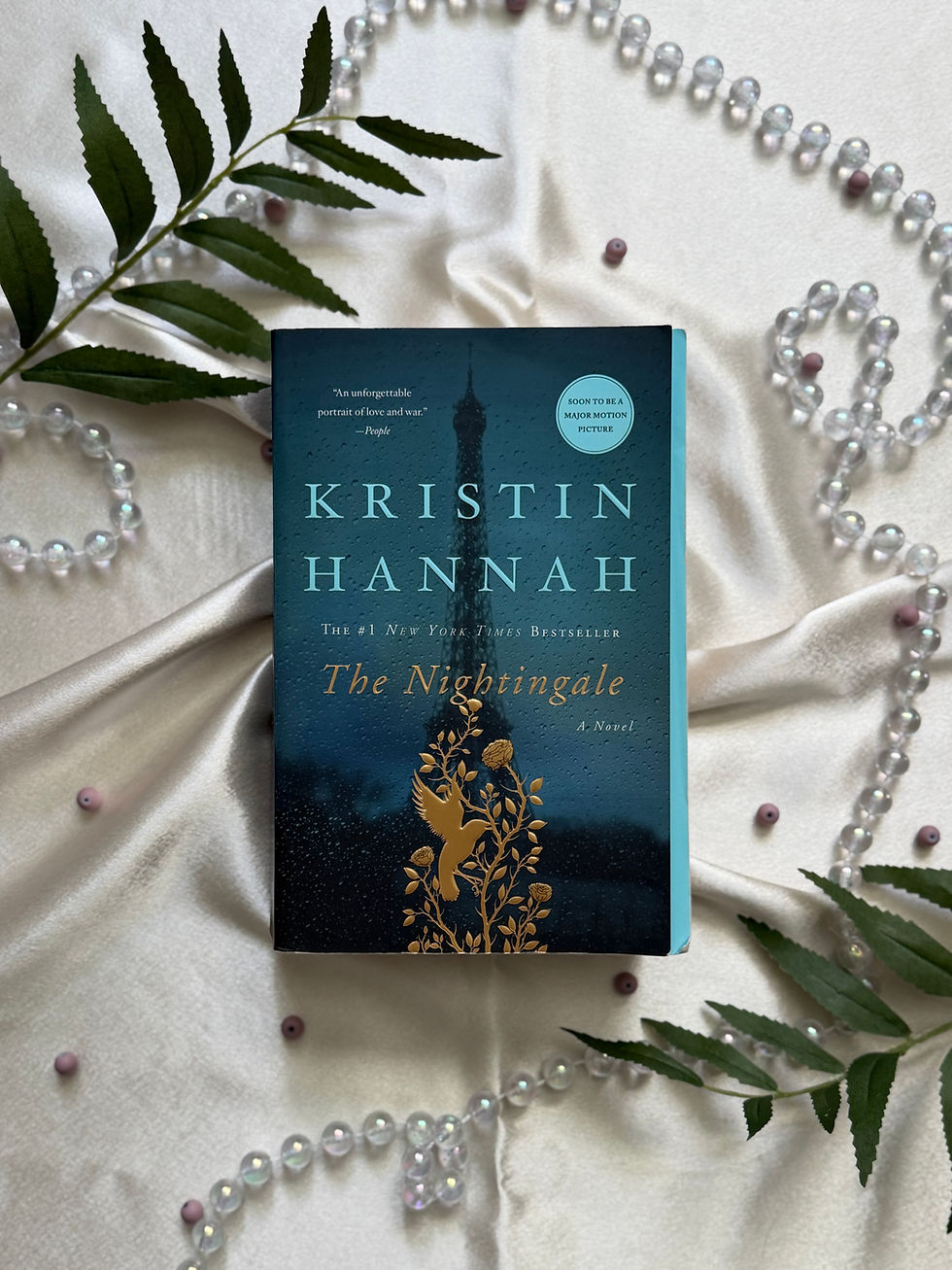
The Nightingale by Kristin Hannah (2015)
Rating: ⭐⭐⭐⭐⭐ As a reader, there are moments when you suddenly know a book is going to stay with you. For months. Years. Possibly even for decades, you will remember that story and how it settled on your heart. For me, this was one of those books.
The Nightingale follows the lives of two sisters, opposite in many ways, during the harrowing years of World War II. Through their story, the author reveals the unseen ways women took action while the men were at war and examines the lengths the human spirit will go to not only survive, but also to protect. To endure. To hope.
A powerful historical fiction that deeply honors the women of World War II, The Nightingale is an emotional whirlwind of a novel that asks us to consider how far we would go to to save the ones we love and fight for what we believe in.
[SPOILERS BELOW]
[SPOILERS BELOW]
The book begins with the words, "...in love we find out who we want to be; in war we find out who we are" (1). I believe that is the lens through which Kristin Hannah built many of her characters. There's the conflict of the ideal and the reality. Some characters rise to the occasion while some fall short of who they'd want to be.
Before we get into the characters, I think it's important to know that while they are fictitious, Hannah has used them to portray the real ways women subversively fought back in WWII. In her research for this book, she found herself increasingly angry that we tell so many stories about the warfare, but we rarely get to hear about the ways women resisted, fought, and endured back home (Author's Note, The Nightingale). Those stories matter too. And these characters are her way of bringing them to light.
Characters:
Vianne Mauriac:
Vianne is the quiet, pragmatic, older sister who represents the more passive, unnoticed methods of resistance. While her fight is largely domestic and provincial it is nonetheless worthwhile. It's in the way she cares for and puts herself at risk for her neighbors, or the way she hides critical information from the Nazis simply by omission, false papers, or even in plain sight. She kept her head down, but in doing so, she made herself unnoticed. And an unnoticed enemy is often more dangerous and effective than one you can plainly see. Vianne's efforts lead to nearly twenty Jewish children being smuggled out and saved, going on to have full lives they would have lost without her. Real women made similar efforts and the risks they took made a generational impact we can see today. Vianne represents those women.
Isabelle Rossignol:
The younger sister, and Vianne's foil in every way, Isabelle is a fiery rebel who cannot be made to sit tight and weather the storm as many women were encouraged to. Isabelle represents the active ways women in WWII took steps to fight back. Whether that was quietly sabotaging Nazi activities, passing information across enemy lines, or rescuing downed airman, Isabelle's actions showed how real women were not content to bow to their enemy and put themselves at extraordinary risk too by joining another form of fighting.
As a character, Isabelle yearns for action, for impact, and ultimately, to matter. The end of her story broke me. I was helplessly crying on an airplane as she survived the concentration camps only to die in the arms of the man she loved. At her core, she's a girl who just wants to be loved and truly matter to someone. In her final moments, she knows peace and her final wish is to not be forgotten. In the end, we see the full impact of her life and bravery; they allowed so many to have a life. What's so heartbreaking is she never got to see it.
Captain Beck:
I think there's a duality offered in Captain Beck's character that's meant to humanize some of the early Nazi soldiers. Many had joined to honorably serve their country before Hitler took power and found themselves forced to make impossible choices once he took control. We see Vianne struggle with this aspect of him too, as she knows he's truly a good man. Beck quickly realizes the war he's wrapped up in is not the honorable endeavor he was led to believe but we see him doing his best—mitigating violence, offering support, making himself as little of a burden as possible. War showed him to be someone who was trying to do good where he could, despite being trapped on the wrong side of history. I think there's a good bit of redemption in that.
Sturmbannfurher von Richter:
von Richter is the epitome of what everyone thinks a Nazi is: cruel, power-hungry, and full of hate. He represents the darkest parts of humanity and is the foil to Captain Beck. He's undoubtedly a very evil character, but we get a glimpse of his psychology too. Vianne notices a pattern that when things don't go well for him at work, he returns home to cause pain and suffering, trying to reestablish his own feelings of control. War reveals him to be a cruel, hollow man. There is no love in him, thus this is all he is.
Sophie Mauriac:
Sophie represents all the children who had to grow up during WWII. Vianne does everything she can to protect her daughter, to preserve her childhood as long as possible. But the harsh realities can't be kept at bay, so Sophie and her mother form a bond from bearing these burdens together. Sophie represents childhoods lost, but hope to be found as she finds joy again when the war passes.
Themes:
Sacrifice:
Sacrifice is written all over this book and touches nearly every character: Vianne for her daughter and Rachel, Isabelle for her Vianne and France, Gaëtan for Isabelle, Rachel for Vianne, their father for his girls, Captain Beck for Vianne. They all go about it in ways that vary from good, to honorable, and even misguided, but any war demands that people make hard choices. What or who they're willing to sacrifice for reflects who they are in their core and I think through all these different examples within her characters, Hannah is showing how sacrifice doesn't have to be done effectively to still matter.
Women's Resilience:
The idea of women's ability to endure hardship is woven throughout the story. We see it demonstrated in nearly every female character: Vianne outlasting each Nazi soldier in her home, Sophie enduring a childhood fraught with tragedy, Isabelle making the treks over the mountains and surviving the concentration camp, Rachel bearing Jewish indignities. They do what they must to survive, then they move on to better things and find salvation in those they love. I think Hannah points to this theme best when Vianne says, "Men tell stories. Women get on with it" (561).
Family:
We see the lines of family get blurred throughout the novel. This is 'found family' in a totally different sense than the modern trope. Vianne takes in Rachel's son as her own, she aids in rescuing other people's children at great risk to her own, and in the end, she chooses to love her abuser's son in spite of his parentage. We see how family becomes those you choose to love, who will love and protect you, regardless of birth.
Identity/Legacy:
The first line of the novel asks us to consider if identity is who we are in the worst of situations or if it is the ideal we strive for. Could it be both? In her love for her son, Sophie, and Ari, Vianne discovers her endless capacity to love. And to risk everything for that love. Isabelle, in her love for her country, discovers bravery. Both of their actions, motivated by love, launch a legacy that affected hundreds. If who we are in love is who we're constantly striving to be, does that make it any less real, any less woven into our being? I think there's something to be said for the ideal we consistently reach for and the impact it can have.
Writing/Literary Elements:
I really enjoyed Hannah's writing style and the way she set up her book. I felt like she did a great job of maintaining this foreboding feeling in every scene; you never knew when the next harrowing event would occur and I think that's reflective of how it might have felt to live in those years. The tone and pacing was well executed without being sensational or too heavy. And the setting of a war-torn France felt real and well-informed. Some of the external events, I'm sure, were honoring real moments in history as well.
The way she set things up with the flashbacks to 1995 were interesting because you didn't know which sister survives for a while. As you get farther into the novel, you begin to understand that whichever sister the old woman is, the weight and impact of both their lives (and the lives of those real women too) carried seismic echoes into the present.
The symbolism of an actual Nightingale was a nice choice for the title. Vianne and Isabelle's maiden names were Rossignol which means "Nightingale." This then becomes Isabelle's code name and a major symbol for the French resistance. Unlike most birds, Nightingales sing at night and like the birds, our characters were finding ways to cry out in the darkest of times.
Ending / Final Thoughts:
In an interview with Kristin Hannah, (conveniently located in the back of my book, actually) she is asked what she hopes readers will take away from her novel. She responds by saying throughout her research, she "was consumed by a single haunting question...when would I, as a wife, and mother, risk my life—and more important, my child's life—to save a stranger?"
She goes on to admit that this question is the very heart of The Nightingale and she's asking her readers to ask themselves, "what would I do" because that question is as important today as it was seventy years ago. I can't speak for everyone, but I could only hope that the bravery of these characters, inspired by real women, would be on my mind should I ever have to ask myself the same.

Comments